Imaginary evil is romantic and varied; real evil is gloomy, monotonous, barren, boring
The FriendImaginary evil is romantic and varied; real evil is gloomy, monotonous, barren, boring is the narrator’s summation of what she learned from reading women’s accounts of suffering. The expression turns on a stark contrast: imagined evil can take many forms, while the reality the women describe recurs with a bleak sameness. It also marks the final conversation the narrator recalls having with her friend before the friend’s death.
Workshop Stories and Repetition
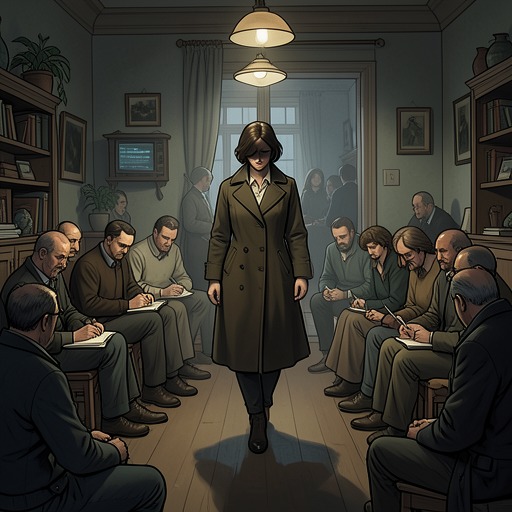
Week after week, the narrator reads the women’s stories on the bus ride home. Individually written accounts begin to merge in her mind into what seems like one large, repeatedly told story: people are hurt, made to suffer, and treated as things. The expression grows out of that repetition, not from an abstract speculation about evil but from sustained attention to what the women have written.
The pattern is audible in the stories’ recurring vocabulary: objects associated with threat and injury, and verbs describing force and deprivation. The repeated words make distinct accounts seem to share a single harsh grammar. Their similarity is not presented as evidence that the women’s experiences are interchangeable; rather, it exposes how persistently the same kinds of harm recur across what they write.
The Fairy-Tale Exercise
The workshop’s invitation to write a fairy tale gives some women a chance to imagine revenge. Yet even in this imaginative form, the stories return to violence and humiliation, and their vocabulary remains repetitive. The exercise therefore sharpens the contrast at the center of the expression: fantasy can offer a space for imagined retaliation, but the stories’ actual language bears the imprint of recurring experience.
The narrator connects this observation to a piece of advice her friend had often given her: writing is never wasted, because even discarded work teaches its writer something. The expression is the lesson she draws from the workshop material. The women’s stories show her that real evil does not acquire the imaginative variety that fiction can supply; its force lies partly in its dull recurrence.
Last Conversation and Significance
The narrator identifies this reflection as the last thing she and her friend discussed while the friend was alive. Afterward, the friend sent an email with a list of books that might help the narrator’s research, along with New Year wishes. The expression thus holds two kinds of repetition together: the recurring patterns the narrator encounters in the women’s writing, and the remembered final exchange that gives the insight a place in her relationship with her friend.